Home Gym Lighting Ideas: How to Light a Workout Space You Actually Want to Be In
The lighting in a workout space does more than help you see. It sets the speed of the room. It tells your body whether to wake up or wind down. It is the difference between a corner you walk past and a corner you walk into.
Most home gym setups skip this part entirely. One ceiling fixture, whatever bulb came with it, done. And then we wonder why the space feels flat, or fluorescent, or like the dressing room of a department store.
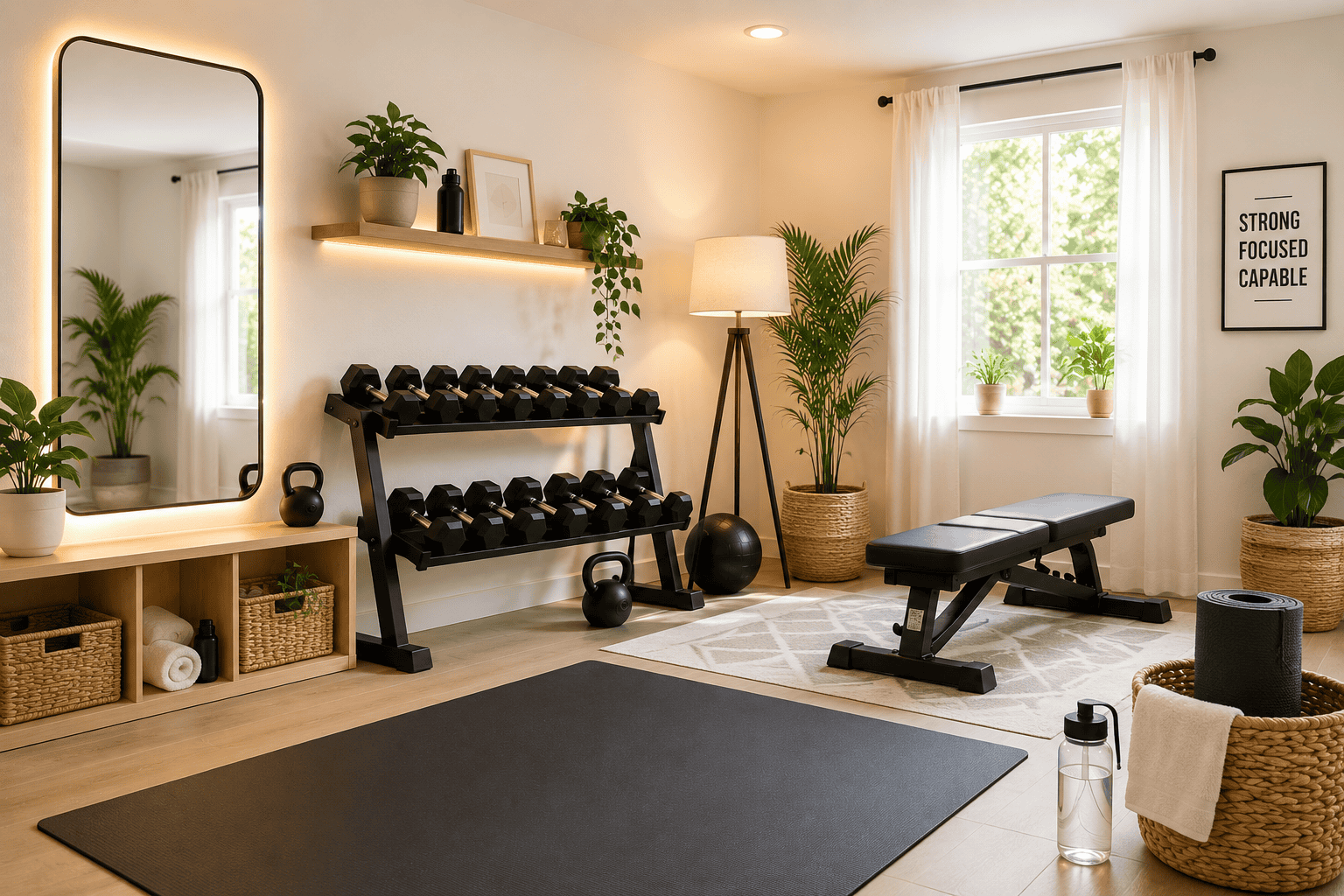
Home gym lighting is the layered combination of overhead, task, and accent light that makes a workout space feel calm in the morning, energized in the afternoon, and dim enough at night that you actually want to stretch in it. Get it right and the room earns its place in the rotation. Get it wrong and you keep finding excuses not to use it.
Here are 10 home gym lighting ideas that work in real rooms with real ceilings, real budgets, and real walls you cannot drill into.
1. Build the Lighting in Layers (Not One Big Fixture)
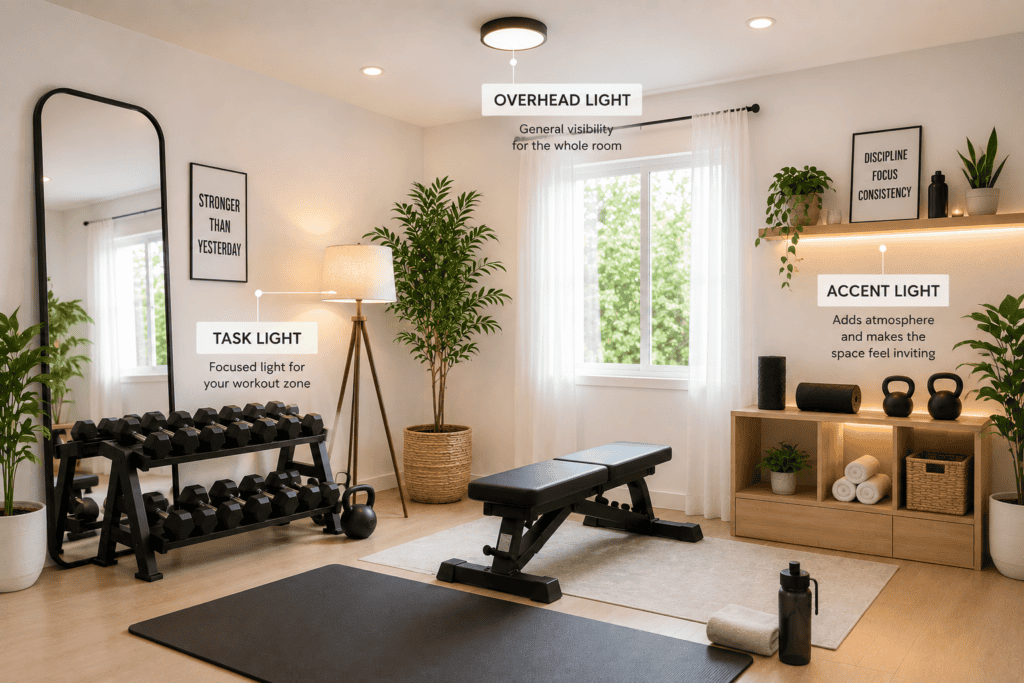
The single biggest mistake in home gym lighting is relying on one overhead source. One fixture is flat. It washes the room evenly, which sounds good in theory but reads as bland and slightly clinical in practice.
Designers think in three layers. Overhead light for general visibility. Task light for the spot you actually move in. Accent light for atmosphere. Stack all three and the room reads as designed instead of installed.
When I was studying interior design at FIDM in Los Angeles, we used to walk through the Pacific Design Center showrooms, and the rooms that stuck with me were not the ones with the prettiest single fixture, they were the ones layering up-lighting, track lighting, strip lighting, mood lighting, and a single low chandelier into one space that could shift entirely depending on which switch you flipped.
A simple version at home: ceiling light on a dimmer, a floor lamp in the corner, and an LED strip behind a shelf or under a bench. That is three layers. That is the whole move.
Pro Tip: If you can only add one layer to your existing setup, add the accent. It is the layer that turns a functional room into a room with a vibe.
2. Put Everything on a Dimmer
Dimmers are the cheapest upgrade with the biggest payoff. A morning yoga session and a Tuesday-night strength session need different light levels in the exact same room, and a dimmer is how the same fixture serves both.
If your fixture is hardwired, swap the wall switch for a dimmer-compatible one. If you rent, use a smart bulb that dims from your phone, or a plug-in dimmer for lamps. The goal is range, not brightness.
Pro Tip: Look for warm-dim bulbs. As they dim down, they shift from neutral white to amber, the way real candlelight does. That shift is what makes a dim room feel intimate instead of just dark.
3. Choose Warm Bulbs (2700K to 3000K)
Bulb color temperature is measured in Kelvin, and the number matters more than most people realize.
- 2700K to 3000K (warm white): soft, amber, residential. The standard for living rooms, bedrooms, and any space meant for unwinding.
- 3500K to 4000K (neutral white): brighter, cleaner, slightly cool. Good for kitchens and offices.
- 5000K and up (daylight): harsh, blueish, fluorescent. The reason commercial gyms feel bad.
For a home gym, default to 2700K or 3000K across every fixture. You can layer in one cooler task light for form-checking if you need it, but the base of the room should stay warm.
I am also speaking from a slightly biased seat. I have a brain injury that makes me physically sensitive to light, and cool blue overhead bulbs give me a headache within minutes. I gravitate to warm and dim because anything else is unusable for me. That sensitivity made me pay attention to bulb temperature long before it was a design preference, and what I learned working around it is that almost every woman I have set up a space for actually feels better in warm light too. Most people just have not been given the choice.
Pro Tip: Check the Kelvin number on the bulb box before you buy. Most brands print it in small text near the wattage. Mixing temperatures across fixtures is the fast way to make a room look uneven.
4. Add an LED Strip for Accent Glow
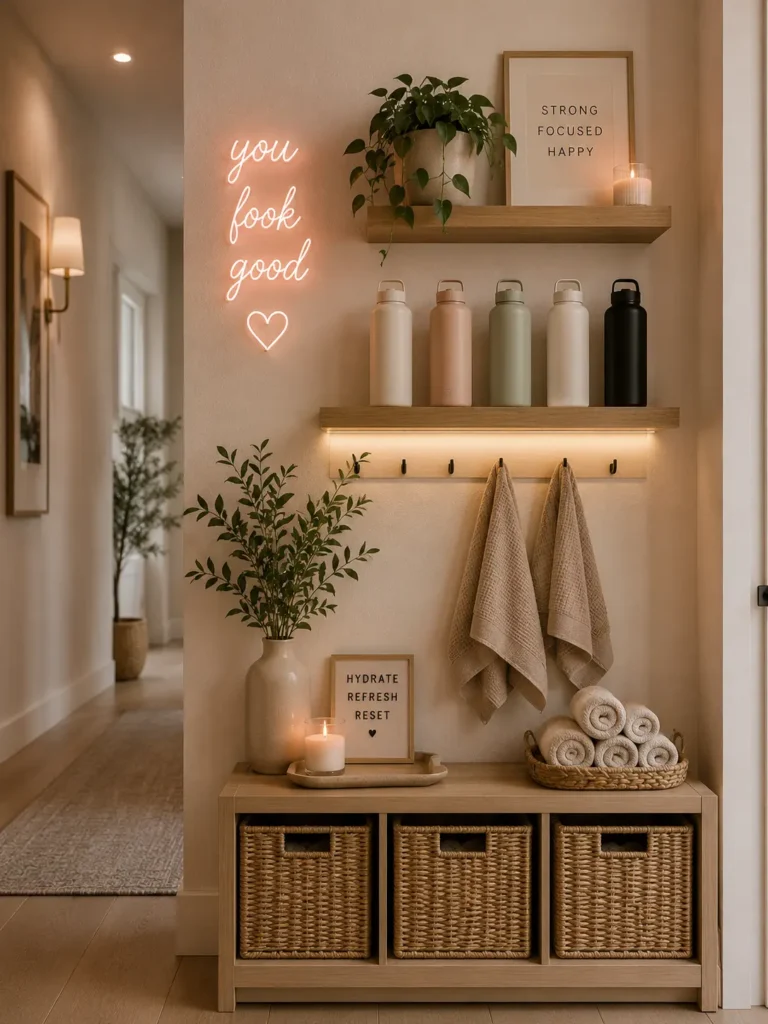
LED strip lights are the easiest atmosphere upgrade you can make. Run a strip behind a shelf, along the top of a mirror frame, or under the lip of a bench, and the room gets an instant ambient glow without a single new fixture.
Pick a strip with adjustable color temperature so you can shift it warmer or cooler depending on the workout. Most plug-in strips run under twenty dollars and stick on with adhesive backing.
The trick is to hide the strip itself. You want to see the glow, not the diodes. Place it behind something that bounces the light onto a wall.
Pro Tip: Put the strip on a separate switch from your overhead light. That way you can turn off the ceiling light and still have the accent glow on for cool-downs and stretching.
5. Use a Floor Lamp Instead of a Second Ceiling Fixture
A floor lamp in the corner of a workout space does a lot of work. It adds a second layer of light without needing to drill anything into the ceiling. It pulls the eye toward the corner and makes the room feel finished. And it lets you turn off the overhead fixture entirely on lower-energy days.
In every LA apartment I rented through my twenties, I was not allowed to swap a single ceiling fixture. The floor lamp became the move by default. I would buy one tall warm-shaded lamp, plug it in across from whatever bare ceiling bulb the building gave me, and it changed how the room felt without changing anything I would have to undo at move-out. Renters: this is the cheat code.
Look for a tall lamp with a fabric or paper shade, which softens the light. Avoid bare bulbs and tight metal cones, which read as harsh.
For more on softening a workout corner, see 12 aesthetic home gym ideas you’ll actually want to copy.
Pro Tip: Position the floor lamp opposite your main fixture. Two light sources on opposite sides of the room is what kills shadows on your face when you film yourself or check form.
6. Treat Natural Light Like a Design Element
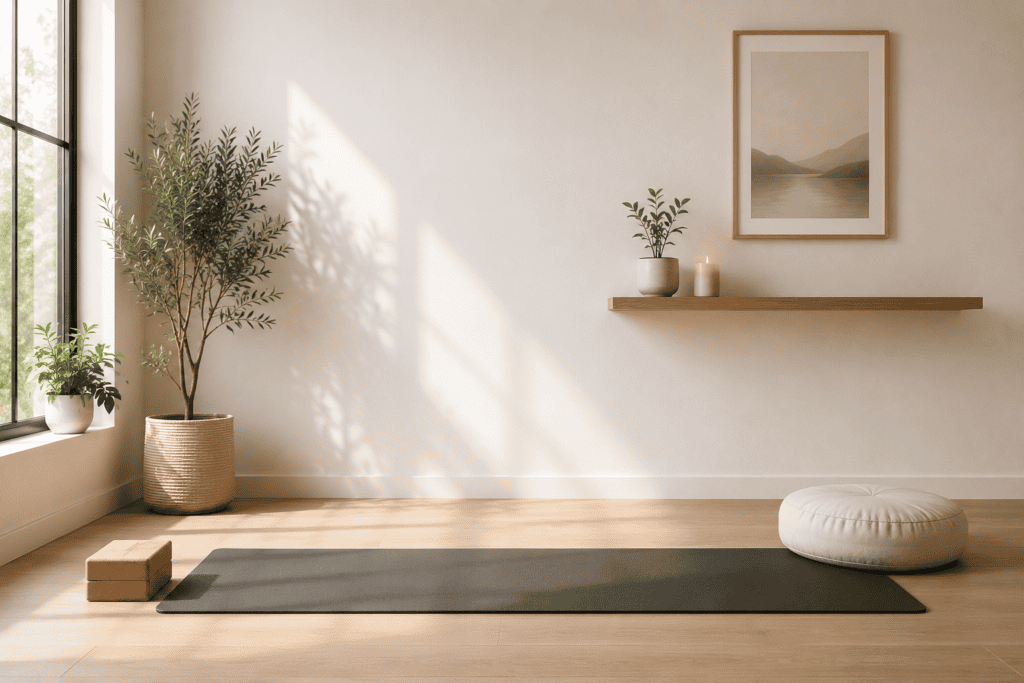
If your space has a window, you already have the best light in the building. The trick is controlling it.
Sheer curtains diffuse direct sun without darkening the room. Heavier curtains or blackout panels give you the option to work out at sunrise without squinting. Bamboo or woven shades add texture and warmth that match the natural-materials direction most home gyms move toward.
If your only window is small or unfortunate, lean a tall mirror across from it. Mirrors double the natural light and make the window feel bigger.
Pro Tip: South-facing windows give you the most light all day. East-facing windows are best for morning workouts. North-facing windows give you the softest, most even light, which is what designers actually prefer.
7. Light the Mirror, Not Just the Room
If you have a gym mirror, light it directly. A mirror in a poorly lit room reflects shadows back at you, which makes everything look worse than it is. A well-lit mirror reflects the room back cleaner and brighter.
The cleanest move: an LED strip along the top of the mirror frame, or a small puck light on either side. Avoid lighting from above only, which casts harsh shadows under your eyes.
Pro Tip: If your mirror sits opposite a window, you have already done most of the work. Just make sure no fixture or shelf blocks the daylight from hitting it.
8. Use Smart Bulbs for Workout-Specific Scenes
Smart bulbs sound like overkill until you have them. The point is not the gadget factor. The point is being able to set one button for “morning yoga” (low, warm, soft) and another for “strength training” (brighter, slightly cooler, full layers on) without fiddling with switches between sets.
Most smart bulb apps let you save scenes. Set two or three. Use them on your phone or a wall-mounted button.
Pro Tip: If smart bulbs feel like too much, a plug-in remote dimmer for your floor lamp does most of the same job for ten dollars. The point is reaching for one switch, not three.
9. Skip the Overhead Fluorescent
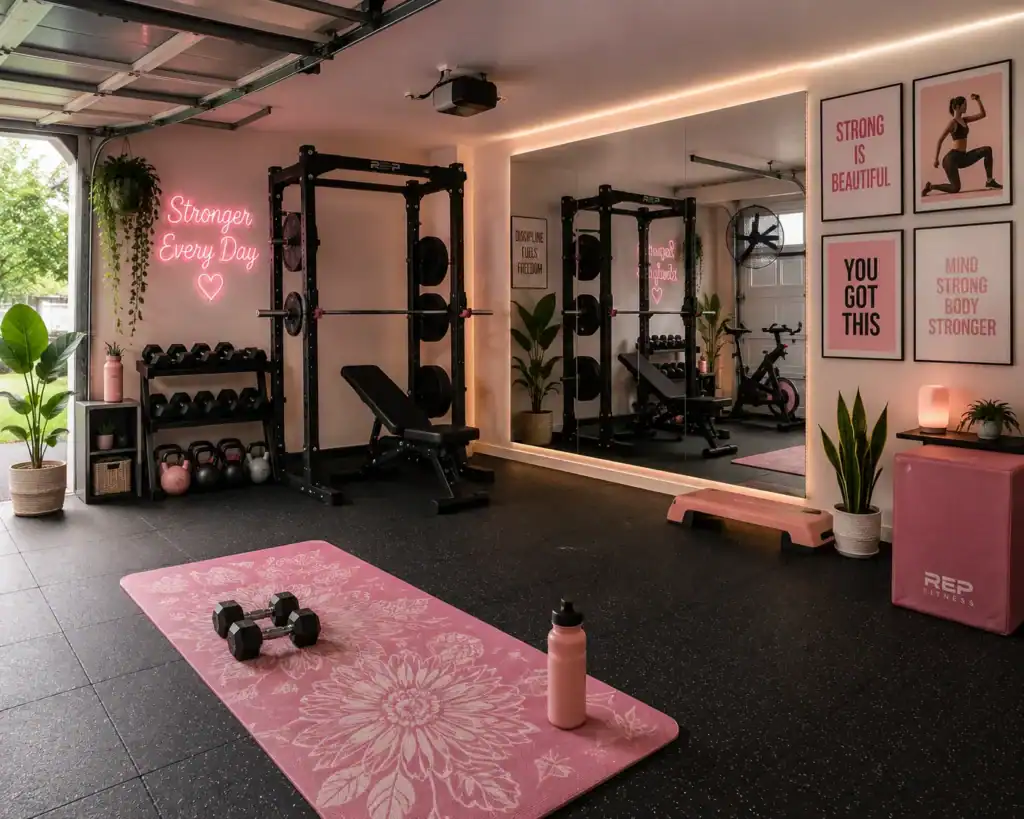
If your basement, garage, or shed came with a fluorescent tube fixture, the single highest-impact change you can make is replacing it.
Replace it with a flush-mount or semi-flush ceiling fixture in a warm finish, with regular dimmable LED bulbs in the 2700K range. The room will feel three times warmer and you have not changed anything else yet.
For more on softening a basement workout space, see basement home gym ideas that feel like a real studio.
Pro Tip: If the fluorescent is hardwired and you cannot swap it without an electrician, just unscrew the tube and leave the fixture empty. Add lamps and accent strips instead. The fluorescent absence will fix more than the fluorescent presence ever did.
10. Match Light to How You Actually Move
The last layer is the human one. Pay attention to when you work out and what your body wants from the room at that hour.
Morning sessions usually want soft and warm, building toward brighter. Afternoon sessions want full layers on, energizing, slightly cooler if you have a smart bulb. Evening sessions want low and warm, the opposite of fluorescent.
The first home gym I ever set up was in our bedroom in Portland. It failed for a lot of reasons, but the lighting was the one I underestimated. My husband worked nights at the time, which meant I wanted to work out at 6am and the room had to be dark for him to sleep. There was no way to light the corner without lighting the bed, and no way to skip lighting the corner without tripping over the kettlebell. The room could not adapt because the lighting could not. I moved the gym out within three months. The lesson was permanent.
A space that lights itself the same way at all hours forces you to work out on its terms. A space that adapts works on yours.
Atmosphere drives endurance. Get the lighting right and the room will let you stay longer than you planned.
Light the Room and the Rest Follows
Most home gym mistakes are equipment mistakes. Lighting is the one most people skip entirely, which is why it is also the one with the biggest swing.
You do not need new fixtures, an electrician, or a renovation. A dimmer, a warm bulb, a floor lamp, an LED strip, and one switch you can reach without crossing the room. That is the whole upgrade.
For more on building a workout space that feels designed: – 12 Aesthetic Home Gym Ideas You’ll Actually Want to Copy – 10 Modern Home Gym Ideas That Don’t Take Over Your Room – Basement Home Gym Ideas That Feel Like a Real Studio
And if you are setting up a space for the first time:
Download The 5-Minute Home Gym Setup Checklist — a quick-start guide to choosing your space, your equipment, and a setup that looks as good as it works.

Free 5-Minute Home Gym Setup Checklist
You don’t need a full home gym. You just need a corner.
No spam. Unsubscribe anytime.
Light it the way you want to feel in it.