
Basement Home Gym Ideas That Feel Like a Real Studio
Basements get a bad reputation. Dark. Cold. Slightly musty. The place where holiday decorations go to live and forgotten furniture goes to die.
But that same basement might be the best room in your house for a home gym. And not just a corner gym. An actual, dedicated workout space with room to move, room to breathe, and room to leave everything set up permanently.
The best basement home gym ideas transform the worst room in your house into the one you look forward to walking into. The key is treating it like a real room instead of an afterthought.
You don’t need to renovate. You don’t need to finish the walls or install track lighting on the ceiling. You just need to address the three things that make basements unpleasant (light, temperature, and moisture) and then build the gym you actually want.
Fix the Basics First
Before buying a single piece of equipment, deal with the basement problems.
Lighting: Most basements have one sad overhead bulb. Add LED shop lights directly above your workout zone. Two to three fixtures creates bright, even coverage. If your basement has no natural light, warm-toned LEDs prevent the space from feeling clinical.
Temperature: Basements run cold. A portable space heater handles this in minutes. Position it at the edge of your workout zone and turn it on 10 minutes before you start. By the time you’re warming up, the space is comfortable.
Moisture: This is the big one. Basements are humid, and humidity means musty smells, slippery floors, and equipment that rusts. A dehumidifier running in the background keeps moisture under control. Empty it once a week (or get one with a drain hose) and your basement will smell like a room, not a cave.
Deal with light, heat, and moisture first. Everything else is design.
Lay the Foundation With Flooring
Rubber interlocking tiles are the foundation of every good basement home gym. They insulate against the cold concrete, protect your joints, reduce noise, and visually define your workout area.
Cover your entire gym zone (not the whole basement). For most setups, that’s 10×12 feet, roughly 15 to 20 tiles. The cost is usually under $100 and the installation takes about 30 minutes.
Pro Tip: If your basement has any moisture issues at all, put a thin moisture barrier sheet under the tiles. It prevents the rubber from trapping water against the concrete.
Create Zones (You Have the Room)
Unlike a bedroom corner or a living room setup, a basement gives you enough space to create separate zones. This is what makes it feel like a real studio.
Strength zone: Your rack, bench, and weights. Against the far wall. Cardio zone: Treadmill, bike, or rower. Near the entrance so air flows. Stretch and yoga zone: A mat area with a softer surface and calmer lighting. In the quietest corner.
Even if your zones are right next to each other, defining them with different flooring, a shelf divider, or just spatial intention makes the space feel like a multi-room studio.
Add a Full Wall Mirror
In a basement, mirrors are even more important than in other spaces. The room is usually dark and enclosed, and a large mirror on one wall doubles the visual depth immediately.
If you can mount a mirror across most of one wall, do it. The space will feel twice as large, and you’ll have form visibility from every angle.
For more on making your gym look as good as it functions, check out 12 aesthetic home gym ideas you’ll actually want to copy.
Pro Tip: Place the mirror on the wall opposite your main light source. The reflected light brightens the entire room.
Paint the Walls (Even if They’re Unfinished)
Exposed concrete block or unfinished drywall makes any space feel temporary. A coat of paint changes that instantly.
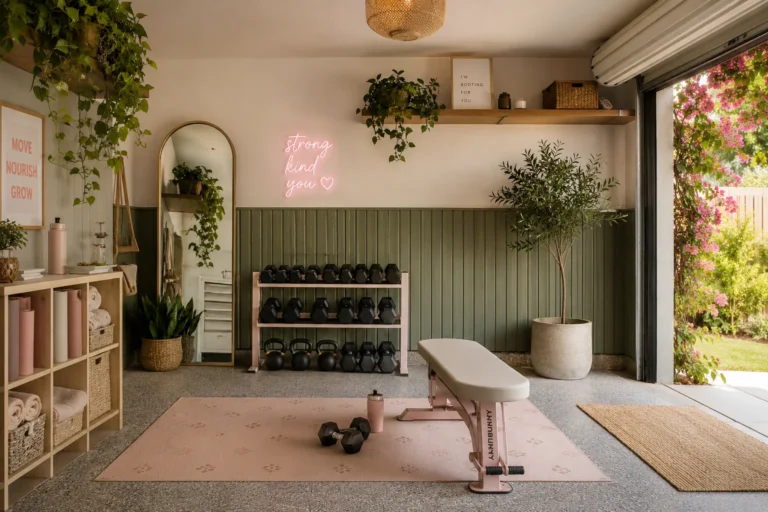
White or light grey makes the room feel bigger and brighter. A dark accent wall behind your equipment adds drama and makes your gym look intentional. Either way, painted walls signal that this is a real room, not a storage area with a bench in it.
If your walls are concrete block, use a masonry primer first. It seals the surface and prevents moisture from bleeding through.
Don’t Skip the Sound
Basements are usually quiet in a heavy, muffled way. That silence can feel motivating or oppressive depending on your preference.
A bluetooth speaker on a shelf fills the space with energy. If your basement has hard surfaces (concrete walls and floors), the sound bounces well and you don’t need anything expensive.
For a more immersive setup, a small soundbar mounted on the wall gives you music quality that makes the space feel like a boutique fitness class.
Make It a Space You’d Show Off
This is where most basement home gym ideas stop. Functional but forgettable.
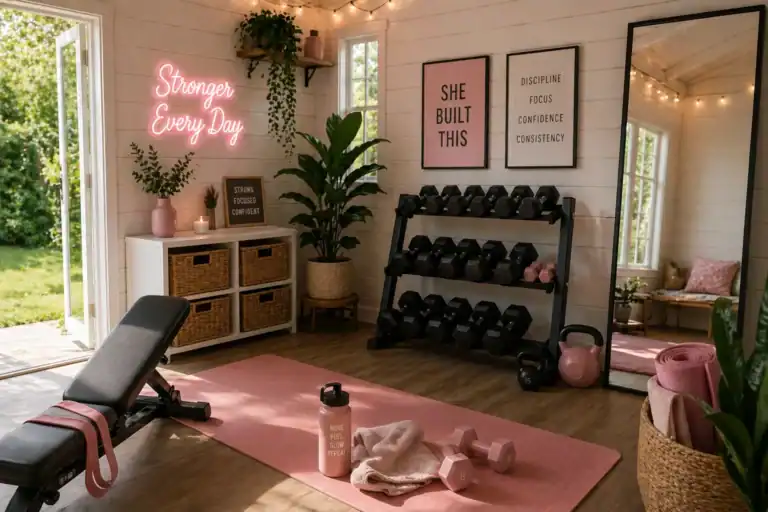
Go further. Add a plant (a pothos in a hanging planter works even in low light). Put up art you like. Use matching storage baskets instead of cardboard boxes. Hang your towels on hooks, not over the bench.
Your basement gym should be a space you’re proud of. When someone asks to see it, you should want to take them down there.
The difference between a basement gym and a basement studio is intention. The equipment is the same. The design is what changes.
Pro Tip: Take a photo from the stairs looking down into your gym. That’s the angle you see every time you walk down. If it looks inviting from there, you’ve done it right.
Consider a Cable Machine or Smith Machine
If you have the ceiling height and the budget, a basement is one of the few spaces where a cable machine or compact smith machine actually makes sense. The weight won’t bother anyone below you (there’s nobody below you), and the permanent setup means you’ll actually use it.
Check your ceiling height first. Most cable machines need 7 to 8 feet of clearance. Many basements have that, but some don’t.
For a more compact option, a functional trainer with adjustable pulleys gives you nearly the same exercise variety in a smaller footprint.
Your Basement Is the Room Nobody’s Using
Most basements sit empty or half-organized, holding things you haven’t looked at in years. Meanwhile, you’re trying to squeeze a workout corner into your bedroom or living room.
Reclaim the basement. Deal with the light, the temperature, and the moisture. Lay flooring. Paint the walls. Hang a mirror. Set up your equipment.
Then go down there and use it.
For more setup inspiration:
- 10 Garage Gym Ideas for Women (From Messy to Magazine-Worthy)
- 12 Aesthetic Home Gym Ideas You’ll Actually Want to Copy
And if you’re starting from scratch:
Download The 5-Minute Home Gym Setup Checklist — a one-page guide to choosing your space, picking your essentials, and building a gym you’ll actually show up to.

Free 5-Minute Home Gym Setup Checklist
You don’t need a full home gym. You just need a corner.
No spam. Unsubscribe anytime.
Your basement has been waiting for a purpose. Give it one.